.png)
This year marked a major step forward for WatchTowers Networks. The work that began after the Black Summer bushfires of 2019-20 has been shaped with emergency services from day one, and 2025 was the year that groundwork turned into real momentum.
WatchTowers Command moved from early adoption into wider operational use. New WatchTowers came online across regional NSW, and agencies on both sides of the ACT/NSW border began working from the same real-time picture. Communities also started relying on CentralWatch to follow local conditions.
Command has been developed with fire agencies from the outset. ACT Rural Fire Service (RFS) and NSW RFS have been our close partners in the rollout, supported by NSW National Parks and Wildlife. They use the platform to improve situational awareness and reduce the time it takes to verify smoke during active fire events. Right now, we’ve got 17 WatchTowers live across southern NSW and the ACT, with 6 more in planning for high-risk areas.
As we head towards 2026, here are some of the moments that defined the year across the regions we serve.
New capability across the network
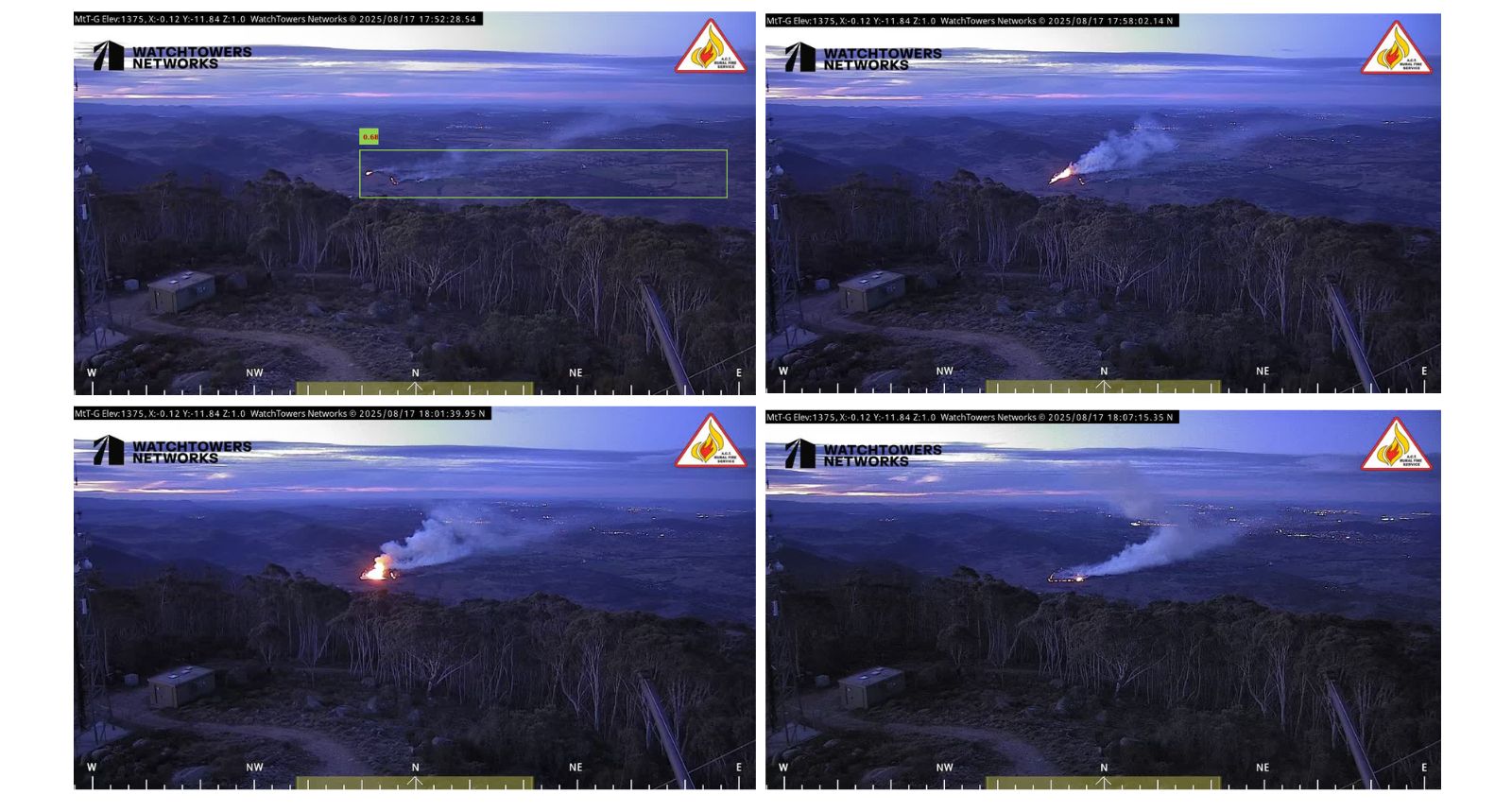
A key advancement this year was the launch of Lookouts.Ai, our in-house smoke detection model built and trained in Australian conditions. It’s now live across the WatchTowers network, helping operators with faster detections and fewer false alerts. We’re proud to report it spots smoke on average four minutes ahead of the human eye, which gives incident controllers extra time during fast-moving days.
We also introduced the Mobile WatchTower, a rapid-deployable unit backed by the NSW Government’s Natural Hazards Detection System program. As demonstrated in the video above, the Mobile WatchTower has the same monitoring capability as a fixed Sentinel Station but can be moved into areas where permanent coverage isn’t possible.
At the end of 2025, three Mobile WatchTowers are operational across NSW in the Hawkesbury, Riverina and Snowy Monaro. The Hawkesbury unit detected 50 smoke sightings in its first week. You can watch the 10 News Sydney coverage of this milestone on Facebook.
For communities, we launched CentralWatch, a dashboard that gives everyone in southern and central NSW access to the same camera feeds and local updates that emergency services use in Command. It has already become a practical way for residents to check conditions around their homes, farms and businesses.
Strengthening coverage across the ACT and NSW
Several new Sentinel Stations came online this year, ready to support the crews who work in that landscape.
In the Riverina, new sites at Galore Hill and Mt Flakney expanded protection across key agricultural areas. These installations were delivered with support from our partners, including Transgrid, Elecnor Australia, NSW Rural Fire Service, the NSW Department of Primary Industries and Regional Development, the Softwoods Working Group and Wagga Wagga City Council. Both stations now feed directly into Command and CentralWatch.

Watch the 7News Riverina story about the Galore Hill installation on our Facebook page.
In the Snowy Valleys, the new Mt Ikes Sentinel Station has added coverage on the southern edge of the region. This site was backed by the NSW Department of Primary Industries and Regional Development, the Softwoods Working Group, NSW Rural Fire Service, the NSW Telco Authority and local emergency services. The installation now supports crews with real-time monitoring and gives communities direct visibility through CentralWatch.

Partnerships that shaped the year
This year reinforced how much our progress relies on the people and organisations working beside us.
We continued our work with Adaptive RF Solutions, a Wagga Wagga-based team that has been installing and connecting Sentinel Stations across the Riverina and Snowy Valleys. Their local experience and practical understanding of the terrain have been central to each successful deployment.
Our long-standing collaboration with the Minderoo Foundation continued to support the evolution of WatchTowers Command. Together we benchmarked several AI smoke detection tools and helped agencies in the ACT and southern NSW bring alerts, calls and camera views into a single operational picture.
We also announced our partnership with the ANU Bushfire Research Centre of Excellence. This includes streaming the Mt Stromlo research camera into CentralWatch and contributing to the AusSmoke dataset. The collaboration will support future testing and field trials that bring new research into operational practice.
Evolving our platforms
The WatchTowers network continued to grow across the ACT and NSW. Crews used WatchTowers Command throughout the year to track incidents, verify smoke reports and coordinate responses across borders. Read our partner story with ACT RFS to find out more about the role these agencies have played in the WatchTowers journey.
CentralWatch has also become a staple for communities who want direct visibility of local conditions. Views from places like Mt Coree, Galore Hill and Mt Flakney have shown everything from early smoke columns to winter snow. It is now a regular point of reference for residents and local brigades.
Underpinning all of this is our WatchTowers Infrastructure: dual-camera Sentinel Stations, local integration work, mobile units and a platform that supports how emergency services already operate. These systems are getting better with each new site, each detection and each collaboration.
The year ahead
Next year will bring its own demands for the regions we support. Our focus stays on the regions that need stronger visibility and on the systems that help crews make faster decisions.
Thank you to everyone who played a part in this year’s progress. Your work helped turn new technology into day-to-day coverage for local crews and communities. If you’re planning a site, expanding a region or want to understand how the system fits into your operations, our team is here to help. Let’s talk.